While many home cooks view Tuna Tataki simply as “seared tuna,” executing this classic Japanese izakaya appetizer requires precise thermal management, an understanding of fish anatomy, and strict adherence to food safety standards.
This guide breaks down the culinary science behind the perfect Maillard reaction, the exact FDA guidelines for raw fish consumption, and the knife skills required to yield melt-in-your-mouth slices.
What is Tuna Tataki? (Tataki vs. Sashimi)
Tuna Tataki (マグロのたたき) translates roughly to “pounded” or “hit” tuna, referencing the traditional 17th-century technique originating in Kochi Prefecture (championed by historical figure Sakamoto Ryoma) where the fish was seared over a straw fire and pounded with ginger and garlic paste.
Today, it refers to a preparation method where a block (saku) of lean tuna is briefly seared over intense heat, plunged into an ice bath to halt the cooking process, and sliced thin.
- Sashimi: Completely raw, sliced fish.
- Poke: Cubed raw fish marinated in a soy-based sauce.
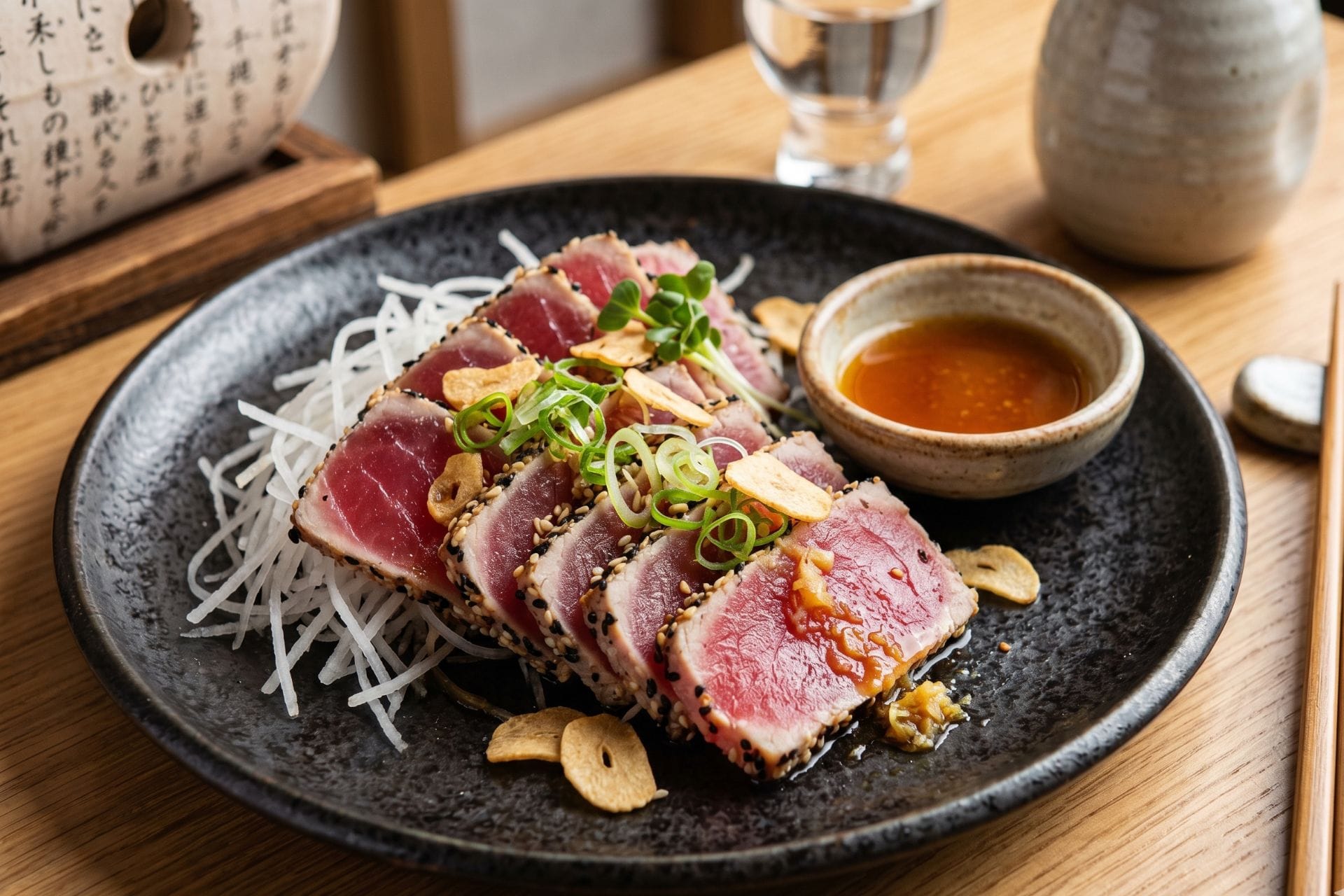
- Tataki: Whole block seared purely on the exterior (1-2 millimeters deep), leaving a cold, raw center, then sliced and served with a citrus-soy ponzu sauce.
Easy Tuna Tataki Recipe and Tuna Tataki Salad and Wafu Dressing
The Food Science: Achieving the Perfect Sear
The biggest mistake made with Tuna Tataki is cooking the center. To achieve a perfectly rare center with a flavorful crust, you must manipulate the Maillard reaction rapidly.
1. Moisture is the Enemy of the Sear
The Maillard reaction (the chemical reaction between amino acids and reducing sugars that creates the browned crust) begins aggressively at roughly 300°F (150°C). If the surface of your tuna is wet, the heat energy from the pan will be wasted on evaporating water (which caps at 212°F) rather than browning the protein.
- The Fix: Thoroughly pat the tuna block dry with high-quality paper towels immediately before searing.
2. Thermal Shock (The Ice Bath Plunge)
Even after you remove the tuna from a smoking hot pan, residual heat continues to travel inward—a process known as carryover cooking.
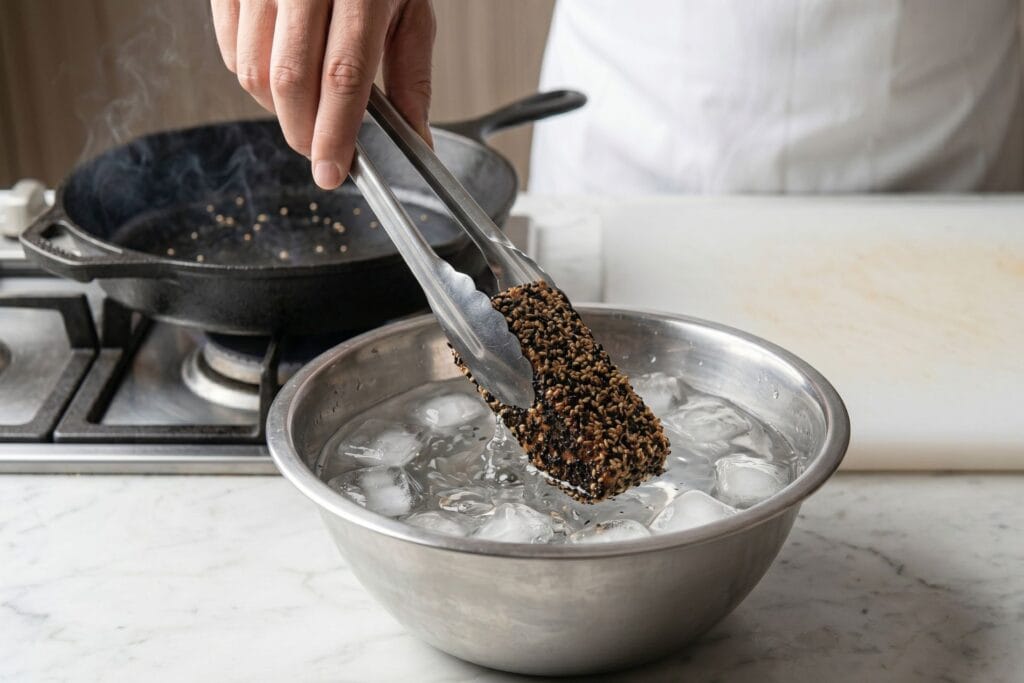
- The Fix: Immediately submerge the seared tuna block into a prepared ice water bath for exactly 30 seconds. This thermal shock violently halts the thermodynamic transfer, preserving the ruby-red center.
Sourcing: Decoding “Sushi-Grade” Tuna
“Sushi-grade” is not a legally regulated term by the USDA. Instead, to ensure safety from parasites when consuming raw or undercooked fish, you must adhere to FDA freezing guidelines.
For tuna to be safe for raw consumption, it must be commercially flash-frozen. The FDA recommends freezing and storing seafood at -4°F (-20°C) or below for 7 days, or freezing at -31°F (-35°C) until solid and storing at -31°F for 15 hours.
Which Tuna to Buy?
- Yellowfin (Ahi) or Bigeye: The standard for tataki. Lean, deep red, with a firm texture that holds up well to searing.
- Bluefin (Maguro): Specifically the lean Akami cut. (Avoid Toro or fatty belly cuts for tataki, as their high fat content renders better when served strictly as sashimi).

Japanese Tuna Tataki
Ingredients
Equipment
Method
- Prepare the Station: Whisk all Ponzu sauce ingredients in a small bowl and set aside. Prepare your ice bath so it is ready the moment the fish comes off the heat.
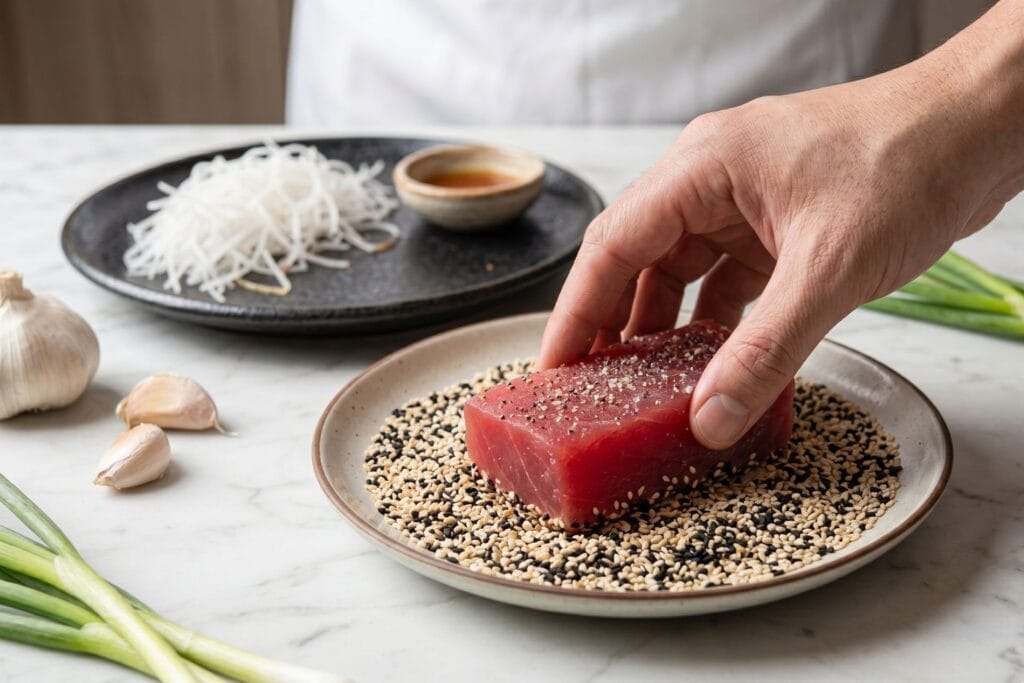
- Prep the Tuna: Remove the tuna from the refrigerator. Thoroughly pat it dry with paper towels. Season all sides evenly with sea salt and coarse black pepper. (If using sesame seeds, press them gently into the flesh now).
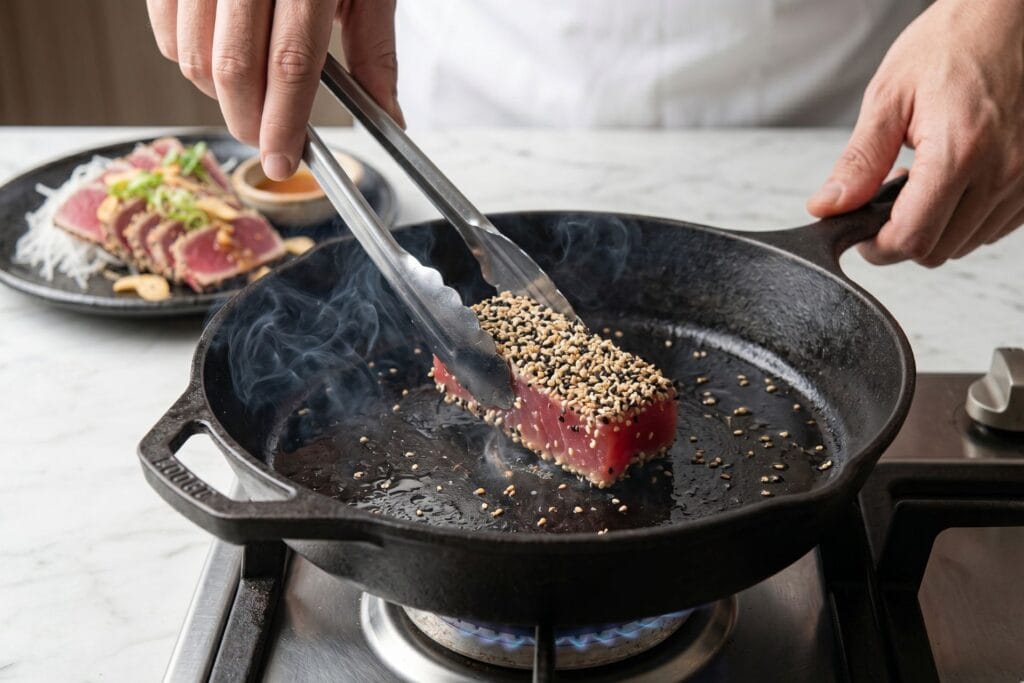
- Heat the Pan: Place your cast iron or carbon steel skillet over high heat until it begins to smoke slightly. Add the grapeseed oil.
- The Quick Sear: Carefully place the tuna block into the pan. Sear for exactly 30 to 45 seconds per side (including the edges). You only want a 1-2mm cooked border.
- The Ice Bath Plunge: Using tongs, immediately remove the tuna and submerge it in the ice bath for 30 seconds to halt carryover cooking. Remove and pat completely dry with fresh paper towels.
Notes
Nutrition
- Calories: 185 kcal
- Protein: 28g
- Carbohydrates: 4g
- Fat: 5g
- Saturated Fat: 1g
- Cholesterol: 45mg
- Sodium: 680mg (Varies depending on the amount of Ponzu sauce used)
- Potassium: 450mg
- Fiber: 1g
- Sugar: 2g
Chef’s Notes & Pro-Tips
- Sourcing the Right Fish: Always explicitly ask your fishmonger for commercially flash-frozen, “sashimi-grade” tuna. Because the center is served completely raw, adhering to FDA freezing guidelines is non-negotiable for food safety.
- Moisture is the Enemy: Thoroughly pat the tuna block completely dry with paper towels before seasoning. If the fish is wet, it will steam in the pan rather than developing that essential Maillard-reaction crust.
- The 30-Second Rule: Do not walk away from the stove. The sear should take exactly 30 to 45 seconds per side on a smoking hot pan.
- Never Skip the Ice Bath: The thermal shock of plunging the seared tuna into ice water halts carryover cooking immediately. Without this step, the heat will continue to travel inward and ruin the raw center.
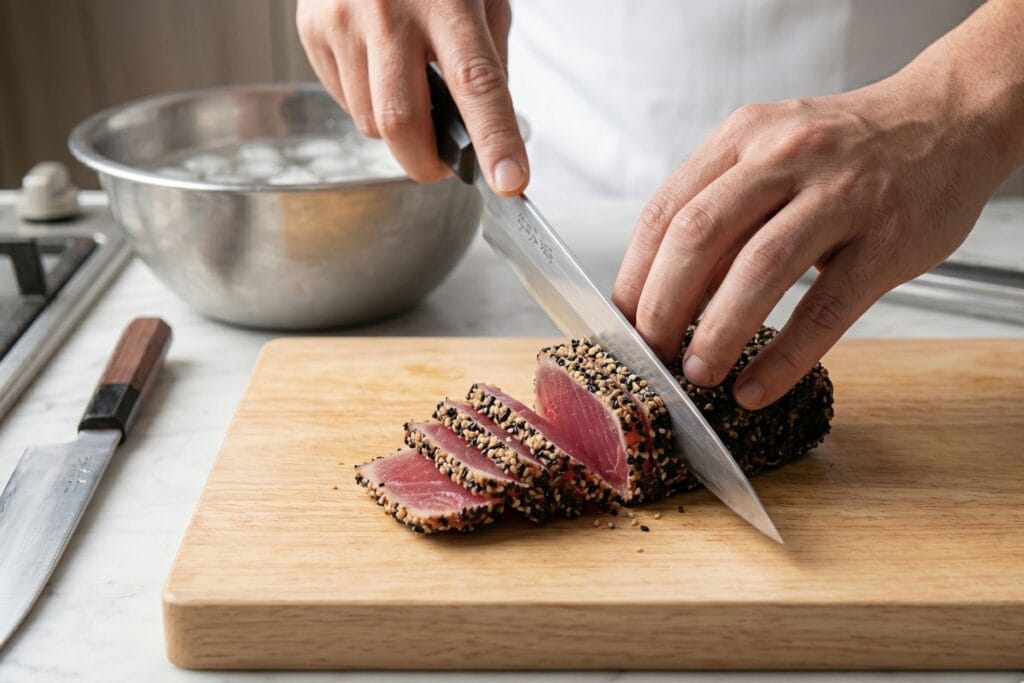
- Slicing Mechanics: Identify the white lines (connective tissue) running through the fish. Always position your knife perpendicular to these lines and slice against the grain for a tender, chew-free texture.
- Storage: Tuna tataki is best consumed immediately. If you have leftovers, store them in an airtight container in the fridge and consume within 24 hours. Do not freeze leftover seared tataki, as it will destroy the texture.
How to Slice Tuna Against the Grain (Anatomical Precision)
If your tuna is chewy, you sliced it wrong. Fish musculature is made of sheets of muscle called myotomes, separated by connective tissue called myocommata (the white lines you see in the fish).
- Identify the direction of the white lines (the grain).
- Position your knife perpendicular (at a 90-degree angle) to those lines.
- Using a long, sharp knife, make clean, continuous slices pulling toward you. Do not “saw” back and forth, as this will tear the delicate flesh. Slice to a thickness of about 1/4 inch (6mm).
Plating and Presentation
To plate like a Michelin-starred Washoku chef, utilize negative space.
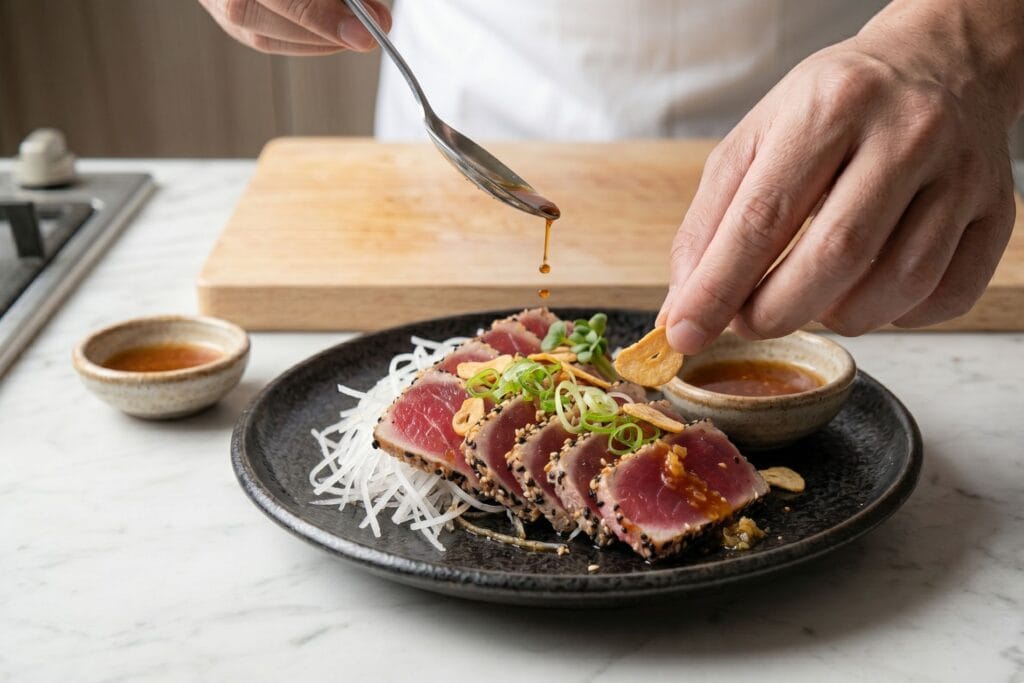
- Create a bed of crisp, julienned daikon radish (tsuma) to elevate the fish and catch the juices.
- “Shingle” the tuna slices (overlapping them slightly) across the plate.
- Spoon the ponzu sauce generously over the slices right before serving.
- Garnish with finely sliced scallions and crispy garlic chips.
Frequently Asked Questions (FAQ)
Can I save leftover Tuna Tataki?
Because the exterior has been introduced to moisture and the interior is raw, leftover tataki should be stored in an airtight container in the refrigerator and consumed within 24 hours. The texture will degrade slightly. Do not refreeze seared tataki, as ice crystals will destroy the cellular structure, resulting in a mushy texture.
What is a tataki tuna?
Tuna tataki is a traditional Japanese preparation where a block of sashimi-grade tuna is briefly seared over high heat, chilled, and thinly sliced, typically served with a citrus-infused soy sauce.
Is tuna tataki raw or cooked?
It is a combination of both; the exterior forms a very thin, cooked crust (usually 1-2 millimeters deep), while the entire center remains completely raw and cold.
What is the difference between tuna tataki and tuna steak?
Tuna tataki is a delicate appetizer requiring a rapid, micro-sear to keep the inside entirely raw, whereas a tuna steak is a thicker entrée cut that is typically cooked much further through.
Is seared tuna high in cholesterol?
No, seared tuna is naturally low in cholesterol—typically containing only about 40-50 milligrams per 3-ounce serving—making it a heart-healthy, lean protein choice.
Is it safe to eat the raw center?
Yes, provided you sourced commercially flash-frozen, sashimi-grade tuna. The brief searing process eliminates surface bacteria, which is where the vast majority of pathogens reside on whole-muscle cuts of meat and fish.
What is the best wine or sake pairing for Tuna Tataki?
The acidity of the ponzu and the umami of the tuna pair beautifully with a crisp, dry Junmai Ginjo sake, or a light-bodied red wine with high acidity and low tannins, such as a Pinot Noir.
More recipe: Liquid Marijuana Drink Recipe: Sweet Tropical Cocktail
Italian Beef Sandwich Recipe (Chicago Style)
Tuaseen is the creator of Recipe Favor, sharing easy, delicious, and homemade recipes for everyday cooking. Passionate about simple meals and flavorful dishes, Tuaseen focuses on creating step-by-step recipes that help beginners and food lovers cook with confidence, enjoy new flavors, and make every meal special at home.